Maths - Discrete
Table of Contents
Sets and Domains
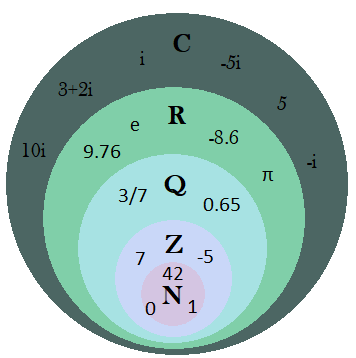
\(\mathbb{C}\) |
Complexs (Real+Imaginary) |
\(-5i, 5, i, 3+2i, 10i\) |
|
\(\mathbb{R}\) |
Reals (All non imaginary) |
\(-8.535, 9.76, \pi, e\) |
|
\(\mathbb{Q}\) |
Rationals (Fractions) |
\(\frac{3}{7}, 0.65, 7\) |
|
\(\mathbb{Z}\) |
Integers (Whole numbers ) |
\(-53337, -5, 0, 7, 19\) |
|
\(\mathbb{N}\) |
Naturals (Integer Positive) |
\(0, 1, 42, 69, 420\) |
Note
\(\mathbb{C} \supset \mathbb{R} \supset \mathbb{Q} \supset \mathbb{Z} \supset \mathbb{N}\)
Notations
\(\exists\) |
Exists |
At least one element |
\(\forall\) |
for All |
All elements |
\(\in\) |
In |
Is included in |
\(\notin\) |
Not in |
Is excluded from |
\(\cup\) |
Union |
Elements in A or in B |
\(\cap\) |
Intersection |
Elements in A and in B |
Extensional definition of a set
\(A = \{x \in \mathbb{R} / x^2 + 2x - 3 = 0\}\)
Propositional calculus and Logic
Connectors and expressions
\(\lor\) |
Or |
\((1 \lor 0) = 1\) , \((0 \lor 0) = 0\) |
\(\land\) |
And |
\((1 \land 0) = 0\) , \((1 \land 1) = 1\) |
\(\neg\) |
Not |
\(\neg 1 = 0\) , \(\neg 0 = 1\) |
\(\uparrow\) |
Sheffer |
\(p \uparrow q \Leftrightarrow \neg(p \land q)\) |
\(\downarrow\) |
Pierce |
\(p \uparrow q \Leftrightarrow \neg(p \lor q)\) |
Boolean logic
\(\mathbb{B} = \{ 0 , 1 \}\)
\(p \in \mathbb{B}, \left\{ \begin{array}{l} p = 0 \Leftrightarrow \neg p = 1 \\ p = 1 \Leftrightarrow \neg p = 0 \end{array}\right.\)
\(p\) |
\(q\) |
\(p \lor q\) |
\(p \land q\) |
\(\neg p\) |
\(0\) |
\(0\) |
\(0\) |
\(0\) |
\(1\) |
\(0\) |
\(1\) |
\(1\) |
\(0\) |
\(1\) |
\(1\) |
\(0\) |
\(1\) |
\(0\) |
\(0\) |
\(1\) |
\(1\) |
\(1\) |
\(1\) |
\(0\) |
Reciprocal and Contraposed
Reciprocal
\(p \Rightarrow q \Leftrightarrow q \Rightarrow p\)
Contraposed
\(p \Rightarrow q \Leftrightarrow \neg q \Rightarrow p\)
Simplification
Conjunctive Form
It is a conjunction of sub-propositions composed only of \(\lor\) and \(\neg\)
example: \((p \lor \neg q \lor r) \land (\neg q \lor r) \land (p \lor q)\)
Disjonctive Form
It is a disjonction of sub-propositions composed only of \(\land\) and \(\neg\)
example: \((p \land \neg r) \lor (r \land q \land \neg r) \lor (q \land r)\)
Probability
Conditional probability
\(\mathit{P}_{B}(A)\): Probability of A knowing B
\(\mathit{P}_{B}(A)=\frac{P(A \cap B)}{P(B)} \Leftrightarrow P(A \cap B) = \mathit{P}_{B}(A) \times P(B) = \mathit{P}_{A}(B) \times P(A)\)
\(Independence \Rightarrow P(A \cap B) = P(A) \times P(B)\)
Discrete Variable
\(E(X)=\sum_{i=1}^{n}[xi \times P(xi)]\) |
\(V(X)=\sum_{i=1}^{n}[xi-E(X)]^2\) |
\(\sigma(X)=\sqrt{V(X)}\) |
- Bernouilli
Bernouilli Formula
\(P(X=k)=C_k^n \times P(A)^k \times (1-P(A))^{n-k}\)
We have two exclusive values, success \(A\) (favorable) and failure \(\overline{A}\), with the probabilities \(P(A)=p\) and \(P(\overline{A})=q\). The experiment is repeated n times in an identical and independent manner, with X the number of successes.
According to the statement […], X therefore follows a binomial distribution of parameters p = … and n = …
\(E(X)=np\) |
\(V(X)=npq\) |
\(\sigma(X)=\sqrt{V(X)}\) |
- Exemple, We Roll 3 dice. What is the chance to have 2 times the 1?
\(B(3;\frac{1}{6}), P(X=2)=C_3^2 \times \frac{1}{6}^2 \times \frac{5}{6}^{1}=0.0694\)
- Poisson
Poisson Formula
\(P(k)=P(X=k)=e^{-\lambda} \times \frac{\lambda^k}{k!}\)
\(E(X)=\lambda\) |
\(V(X)=\lambda\) |
\(\sigma(X)=\sqrt{V(X)}\) |
- Exemple, one more person every 40 seconds. What is the chance to have 4 persons in 2 minutes?
\(dt=40s, T=2 \times 60=120s, n=\frac{T}{dt}=\frac{120}{40}=3(expectation)\) \(\lambda=p \times n = 1 \times 3, P(X=4)=e^{-3} \times \frac{3^4}{3!}=0.168\)
Continuous Variable
- Exponential
Exponential Formula
\(P(0 \geq X \geq x)=1-e^{-\lambda x}\\P(X\leq x)=e^{-\lambda x}\)
\(E(X)=\frac{1}{\lambda}\) |
\(V(X)=\frac{1}{\lambda^2}\) |
\(\sigma(X)=\frac{1}{\lambda}\) |
- Exemple, Lambda=6.116x10^(-4), Probability that T > 1000?
\(P(T>1000)=1-P(T \leqslant 1000)=e^(-\lambda \times 1000)=0.542\)
- Uniform
Reduced Centered Uniform Formula
\(f(t)=\frac{1}{b-a}\) if \((t \in [a,b])\), else \(0\)
\(E(X)=\frac{a+b}{2}\) |
\(V(X)=\frac{(b-a)^2}{12}\) |
\(\sigma(X)=\sqrt{V(X)}\) |
- Reduced Centered Normal
Normal Formula
\(T=\frac{X-m}{\sigma} N(0,1)\)
95% |
98% |
99% |
|
1.96 |
2.33 |
2.58 |
\(f(t)=\frac{1}{\sqrt{2\pi}} \times e^{-\frac{t^2}{2}}\)
\(\prod(t)=P(T<t)=\int_{-\infty}^{t} (\frac{1}{2\pi} \times e^{-\frac{t^2}{2}})dt\)
Comparison
- Expectation
\(X=320\), observated \(\overline{X}=324\), \(\sigma(X)=3\) and \(N=100\)
\(Z=\frac{\mu - \overline{\lambda}}{\frac{\sigma(X)}{\sqrt{n}}}=-13.3, |Z|>1.96 (significative)\)
- Exemple, A=N(1030,5)n1=10 and B=N(995,7)n2=20
\(Z=\frac{1030-995}{\sqrt{\frac{5^2}{10}+\frac{7^2}{20}}}=15.7 \geqslant 1.96 (5\%)\)
Approximation
- Binomial by Normal
Binomial Formula
\(T=\frac{X-np}{\sqrt{npq}}\)
\(E(Y)=np\) |
\(V(X)=npq\) |
\(\sigma(Y)=\sqrt{V(X)}\) |
- Binomial by Poisson
Poisson Formula
\(\lambda=np\) \((n \geqslant 30, p \leqslant 0.10, np \leqslant 5)\)
\(E(X)=\lambda\) |
\(V(X)=\lambda\) |
\(\sigma(X)=\sqrt{V(X)}\) |
- Poisson by Normal
Normal Formula
\(T=\frac{X-\lambda}{\sqrt{\lambda}}\)
\(E(X)=\lambda\) |
\(V(X)=\lambda\) |
\(\sigma(X)=\sqrt(\lambda)\) |
Distribution
Normal Median
\(\overline{X} \Rightarrow N(\mu, \frac{\sigma}{\sqrt{n}})\) for an infinite population, else \(m=\frac{\sigma}{\sqrt{n}} \times \sqrt{\frac{N-n}{N-1}}\)
- Exemple, 5 machines, 500g packages with sigma=5g and 20 packages collected per machine. What is the probability of 499g or under?
\((\mu=500, \sigma=5) \Rightarrow N(500, \frac{5}{\sqrt{20 \times 5}})\)
\(T=\frac{X-n}{\sigma}=\frac{499-500}{0.5}=-2 \Leftrightarrow P(X \leqslant 499)=2.28\)
Sample Proportion
\(F(p, \sqrt{\frac{pq}{n}}\) for \(n \geqslant 30\)
- Exemple, 1% defective and 5000 pieces collected, certitude if < 1.2% ?
\(\sigma=\sqrt{\frac{0.01 \times 0.99}{5000}} = 0.0014 \Rightarrow N(0.01, 0.0014)\)
\(P(f<1.2)=P(T<\frac{0.012-0.01}{0.0014})=P(T<1.42)=92.22\%\)
Average Estimation
Ponctual Estimation
\(X(\mu=?, \sigma=?) \Rightarrow\) sample of size n \((\mu e, \sigma e)\)
\(m=\mu e, s=\sqrt{\frac{n}{n-1}}\sigma e\)
- Exemple, 13L/day for 21 days, sigma=2L. What would be an average estimation?
\(m=13, s=\sqrt{\frac{21}{20}} \times 2 = 2.049\)
Confidence Interval
confidence coefficient = \(\alpha\), degree of freedom(khi2) = \(\chi^2=\frac{(sample-effective)^2}{effective}\)
if \(n \geqslant 30\) |
Central Limit \(\Rightarrow\) Normal Law \((m, \frac{\sigma}{\sqrt{n}})\) \(P(m \in (a,b))=P(\overline{X}-t \times \frac{\sigma}{\sqrt{n}} < m < \overline{X}+t \times \frac{\sigma}{\sqrt{n}})=\alpha\) |
if \(n < 30\) |
Read Table \(\Rightarrow\) Student Fisher \(P(m \in (a,b))=P(\overline{X}-t \times \frac{s}{\sqrt{n}} < m < \overline{X}+t \times \frac{s}{\sqrt{n}})=\alpha\) |
Proportion Estimation
Ponctual Estimation
\(\sigma(D)=\sqrt{\frac{\sigma 1}{n1}^2 + \frac{\sigma 2}{n2}^2}\)
\(N(p,\sqrt{\frac{pq}{n}}) \Rightarrow f=pe \times \sigma p = \sqrt{\frac{n}{n-1}} \sigma e\)
if \(n \geqslant 30\) |
\(\sigma p = \sqrt{\frac{pe(1-pe)}{n}}\) |
if \(n < 30\) |
\(\sigma p = \sqrt{\frac{pe(1-pe)}{n-1}}\) |
- Exemple, We have a survey with a sample of 160 persons, 40 agree. What is the estimated proportion?
\(N(\frac{1}{4}, \sqrt{\frac{\frac{1}{4} \times \frac{3}{4}}{160}})=N(0.25, 0.03423)\)
Confidence Interval
Confidence Interval
\(P(p \in (a,b))=P(f-t \sqrt{\frac{f(1-f)}{n}} < p < f+t \sqrt{\frac{f(1-f)}{n}}) = \alpha\)
\(\sigma(X)=\sqrt{V(\overline{X})}, \sigma(\overline{X})=\frac{\sigma(X)}{\sqrt{N}} \Rightarrow \mu e = [E(\overline{X}) \pm 1.96 \times \sigma(\overline{X})]\)
- Exemple, We have 64 clients, with an average of 60min, sigma=9.27. What would be an confidence interval at 5% ?
\(\sigma(\overline{X})=\frac{9.27}{\sqrt{64}}=1.159 \Rightarrow \mu e = [60-1.96 \times 1.159; 60+1.96 \times 1.159]\)